Thursday, 7 March 2013

Charles Dickens

Charles Dickens


Charles Dickens was born on February 7, 1812, the son of John and Elizabeth Dickens. John Dickens was a clerk in the Naval Pay Office. He had a poor head for finances, and in 1824 found himself imprisoned for debt. His wife and children, with the exception of Charles, who was put to work at Warren's Blacking Factory, joined him in the Marshalsea Prison. When the family finances were put at least partly to rights and his father was released, the 12 year old Dickens, already scarred psychologically by the experience, was further wounded by his mother's insistence that he continue to work at the factory. His father, however, rescued him from that fate, and between 1824 and 1827 Dickens was a day pupil at a school in London. At fifteen, he found employment as an office boy at an attorney's, while he studied shorthand at night. His brief stint at the Blacking factory haunted him all of his life — he spoke of it only to his wife and to his closest friend, John Forster — but the dark secret became a source both of creative energy and of the preoccupation with the themes of alienation and betrayal which would emerge, most notably, in David Copperfield and in Great expectations.

Charles Dickens

Dickens sprang to fame with his 1836 publication of "The Pickwick papers".  He went on to write numerous pieces and became one of the most famous writers of the Victorian era.  His work is still re-produced to this day and many theatre and film adaptations are still brought to life.


Victorian Theatres


Throughout the Victorian era is the time where literature and theatre flourished.  During the reign of Queen Victoria a lot of new theatres were built.  Theatre began to become popular with the masses, one of the main reasons for this was due to the improvements in the transportation systems.  The streets started to become safer of a night so this gave theatres better opening times so they could attract more people.  All of this led to a greater profit within the industry.  Theatres such as The Royalty, The Gaeity, The Charing Cross, The Globe and The Queen's were all remodelled in the Victorian era.

Oscar Wilde

Oscar Wilde is one of the most famous playwrights of the Victorian era.  "The Picture of Dorian Gray" was Wilde's first successful novel.  He went on to write "Lady Windermere's Fan" which appeared at St James's theatre.  He also produced many other famous plays such as The importance of being earnest.  Other famous playwrights of the era include George Bernard Shaw and Dion Boucicault.  


Victorian Arts & Literature


Victorian literature was produced during the reign of Queen Victoria (1837-1901). Often considered a bridge between the romantic-era works of the previous century and what would become the literature of the newly industrialised world of the twentieth century, Victorian literature is characterised by a strong sense of morality, and it frequently champions the downtrodden. It is also often equated with prudishness and oppression, and while this is sometimes true, Victorian literature is also known for its attempts to combine imagination and emotion with the neoclassical ideal of the accessibility of art for the common person. Some of the best-known authors of this period are Charlotte Brontë (Jane Eyre), Emily Bronte (Wuthering Heights), and Charles Dickens (Great Expectations).


Essential Facts

  1. One of the enduring authors of the Victorian era is George Eliot (a pseudonym for Mary Ann Evans). Virginia Woolf called Eliot’s novel Middlemarch “one of the few English novels written for grown-up people.”
  2. Charles Dickens was a self-made man. He published his first novel, The Pickwick Papers, in 1836. It made him an overnight success, and he was popular all his life. Dickens is still the most widely read novelist of the Victorian era.
  3. All three Bronte sisters—Charlotte, Emily, and Anne—were writers. For a number of years, however, they all published under the male pen names of Currer, Ellis, and Acton Bell.
  4. Literature for children, often with a strong moralistic tone, became wildly popular during the Victorian era. Authors like Lewis Carrol (Alice in Wonderland) and Rudyard Kipling (The Jungle Book) were especially favored.
  5. Edward Bulwer-Lytton is widely regard as the worst writer of the Victorians (although he was immensely popular in his day). Bulwer-Lytton is responsible for this infamous sentence: “it was a dark and stormy night.”
Charles Dickens

Emily Bronte

Charlotte Bronte

Oscar Wilde

Lewis Carroll

Rudyard Kipling


Brusing and Beating Make-up

It is important when trying to achieve a realistic bruise or graze that you research some real-life incidents to re-create the correct effect.  Bruising varies depending on impact and the stage of the bruise, it is vital to get the right colour etc for the right bruise.

A newer bruise
Newer bruises tend to be more red and swollen as impact has only just occurred, the capillaries have been damaged but have not had time to completely die.

Day or two old bruise
As bruises start to mature they begin to form a range of colours.  As pictured above, colours vary from blue, purple, red, green, yellow.... it is key to study a bruise before yo re-inact with make-up.

A more mature bruise

As a bruise becomes more mature the yellow and green tones really start to convey within the area.

Grazing

A graze is more scratched and red and usually contains blood as the skin has been broken.  Again it is vital to understand what caused the wound and where it is to acheive the correct result.

Bruising and Grazing practices


Pictures of black eyes and a grazed face above, slightly unfortunate i think!!!


The above pictures are a bruised cheek, more matured.


The above pictures show a black eye and grazed face at an earlier stage.


Violence in the Victorian era

"Wife Beating" was a regular occurrence in the Victorian era.  A lot of people deemed it as socially acceptable and more linked to the lower classes, but "beatings were common through all the classes.  William Montagu's social investigation Round London: Down East and Up West, tells of women in the hospitals, "Sometimes as many as twelve or fourteen women may be seen seated in the receiving room, waiting for their bruised and bleeding faces and bodies to be attended to... In nine cases out of ten the injuries have been inflicted by brutal and perhaps drunken husbands."


The Victorian perception of religion, domestic principles and laws allowed men to justify "wife beating."  Violence throughout the Victorian era was mainly attributed to the idea that the man was the ruler in all worlds.  Religion suggested "that for a woman to be virtuous and serve God, she must follow the lead of her husband."  This gave men the impression that they had a god given right to control their wives, even if this meant the use of physical abuse.  In domestic principles, the husband was the supreme being in the house and it was his duty to protect his wife.  This authority also allowed him to use violence, if necessary, in order to keep her in line.  


A lot of laws in the Victorian period favoured men.  Men had legal power over most of his wife's possessions, including her wages, children and any inheritance.  This left women feeling enslaved to their husbands.  The comparison between the relationships of a wife and husband versus a slave and his master is very common in Victorian literature concerning domestic violence.  The laws of the Victorian era contributed to this relationship because it gave men the legal right to be overwhelming.  The men casually justified it while women accepted it as a way of life.  


Victorian men's fashion


In the Victorian era, daily dress was much more formal than it is today.  Unless they were a workman or a labourer, every gentleman was expected to wear a coat, vest and hat.  To walk around in shirtsleeves without a vest or coat was like the modern day equivalent of walking around in your underwear.  It was seen as very ungentlemanly and unseemly.


An authentic Victorian vest was the centrepiece of any outfit.  Vests were used to make a fashion statement, either bold or conservative and gentlemen would often own several vests to accessorise the same dark suit.  Victorian gentlemen wore a wide variety of vests in almost every combination of cut, colour and cloth imaginable.  With trade beginning with China during the 1840's silk became readily available and inexpensive, therefore men wore extremely fancy silk vests during the day.  many men would wear their jackets with just the top button fastened so more of the vest could be seen.


Like vests, hats were available in a wide variety of styles.  Top hats were de rigueur for parties and formal events throughout the century, but were also worn as day wear by more established gentlemen.  Derbies or bowlers, short-brimmed with rounded crowns, became more common as the century progressed and by the mid 1890's outnumbered most other hat styles.


The second half of the nineteenth century was dominated by the frock coat, a man's coat with full skirt both front and back that reached just above the knee.   It was common for both day and evening wear through the 1880's, making it the most versatile coat of the Victorian wardrobe.  Tailcoats were popular for most of the century, often used for parties and formal events.  The styling included single and double breasted as well as straight and pointed fronts.


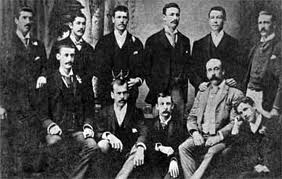
Victorian Men

The Victorian period was a time where social and economic advancements reached unprecedented levels.  The Victorian man was the breadwinner and head of the family and household.  Men were expected to be dutiful and attentive husbands.  Most men would learn their values from there childhood homes and hope to carry them on in their future homes.


Gender was massively characterised by what was know as the private/public divide.  The private sphere of family and household were the women's responsibility while men tended to the public sphere; i.e. work, politics, government.  The man's social identity consisted of home, work and all-male association.


Equally as important to the victorian man's masculinity was the need to leave son's behind to carry on the family name.  The degree of success achieved by the son depended on his upbringing and his ability to be able to stand on his own two feet for manly independence.  His success also depended on the encouragement he received to succeed from his family whilst growing up.